Wednesday, January 11, 2017

How to Get a Better Mix: The Mics

"In general, also in mixing I use very little EQ. 
My mics are my EQ." --Al Schmitt

Hopefully you've heard this before...mixing starts at the mic. I think I've proven it starts well before that, but I digress. Picking the right mics, their placement and proximity to each other is crucial in making records. Even if you're working with synthesized music and a pop vocalist singing over the top of the production...your mic choice could be the difference between a soothing compelling vocal that works for the song or an out of place element on the track that sounds cheap and distracting from the experience of the song. 


There's so much to be said for proper mic technique and though some of the fundamentals can be gleaned from credible books on recording, much of it like any skill is practice, practice, practice. Don't be afraid to take time and find the right spot for that SM57 over the snare drum. Try something new altogether and look up to those who've proven their salt at the skill.


The same mic can sound different at difference distances and angles from the source. So, even if you have the most limited microphone locker, there's still a world of possibilities for you to discover and try on your next recording.

Recommendation: I tend to value books over YouTube videos when it comes to audio instruction, as they've survived the test of time. One that I can recommend to you is "Modern Recording Techniques" by David Miles Huber. It's a great primer into audio engineering and will give you the fundamentals you need to start micing things up with confidence.


Monday, January 9, 2017

Contrasting Art: Al Schmitt & Mike Dean

Inevitably, I find myself in a lot of conversations with engineers on the record making process. When we land on the topic of favorite albums I sometimes cause some eyebrows to raise. A few of my favorite albums are not always technical masterpieces, sometimes far from it, but it doesn't ruin my enjoyment of the music in any way. I love albums like...
  • "St. Anger" by Metallica 
  • "Doolittle" and "Surfer Rosa" by The Pixies 
  • "It Takes a Nation.." by Public Enemy 
  • "Either/Or" by Elliott Smith 
  • "Cypress Hill" by Cypress Hill 
  • "Tim" by The Replacements
...you get the idea... 

Most of these albums you might be able to argue sound 'bad', yet that doesn't stop me from playing them back over and over.

On the other side of the coin, I love some incredible sounding records like...
  • "Eat a Peach" by The Allman Brothers 
  • "Talking Book" by Stevie Wonder 
  • "Bad" by Michael Jackson 
  • "A Love Supreme" by John Coltrane 
  • "Wrecking Ball" by Emmylou Harris 
  • "Da Good, Da Bad & Da Ugly" by Geto Boys 
The only thing some of these albums have in common is that they're made up of music and that I like them. And you may look at these lists and want to rewrite them for me, and that's okay. 

That leads me to my next point...as audio engineers working in the music industry, our job is to help facilitate art. This is art and just like these paintings can exist under the umbrella of art... 


So can these albums...


Many times as engineers, we need to be asking ourselves what tells the story for this artist better, a clean class A preamp or a dusty blown guitar amp. 

There's room for distortion and clarity, and the skill of an engineer is to know how to facilitate both those needs. And the role of the producer is to know which one is appropriate for the project. 

Whether you use Ableton Live or an original Neumann U47's to create your music...the goal is the same...great art. And there's plenty of room for both. 

Sunday, January 8, 2017

How to Get a Better Mix: The Performance

Don't wait for mixing or mastering for your song to feel like a great song, record it that way.

Last year I was lucky enough to get to sit in and watch some master session players in Nashville cut a tune. It was incredible. What came out of the speakers sounded mixed at the onset. Everything just sounded as it should. The engineer leaned over to me and said, "I have the easiest job in the world". And he was right. Great performances make the rest of the process easier. If you have a great song, arrangement and performance, the job of the engineer can just be presentation.

All too often I've seen artists rush in and out of the studio with decent, but not great performances recorded. They might have fronted the cost to track at a world class facility, mix with a chart topping mixer and master with one of the greats, but the album only sounds 'okay'. Their album releases, but is not met by the level of excitement they hoped for.

Where did they go wrong?...

People are still triggered by emotion and experience. If the performance isn't there, no amount of fancy microphones, vintage gear, experienced processing, or level balancing is going to add that into the track.

Great performances of great songs arranged well make for great records. Put in the time required to get these three 'pillars of the production process' right and the rest of it will be much easier.

"Sing from your soul...that's where the magic is"--Quincy Jones

Saturday, January 7, 2017

Plugins Debunked: Slate Digital VTM


Based on two well known Studer tape machines, NRG Recording's A827 and Howie Weinberg's A80, the Slate team took a solid year and a half to capture the idiosyncrasies of these two beloved machines.


Some back story before we continue...

I've spoken to a few engineers, such as Bob Ohlsson of the Motown fame about tape, and his thoughts were, that tape was a cumbersome experience that engineers fought with when it was the only medium for recordings. It had a 'sound', but sometimes that sound interfered with the clarity of the recorded performance. Other times it provided a rich low end and compelling low-mid presence that missed when everything went digital in the 80's.

In recent years, a generation who never experienced working with tape have become nostalgic for it and are incorporating tape emulation plugins into their mixes and productions.

In the early 2000's, first emulations of it were pretty bad...adding a saturation, but not in the least bit accurate to what it aimed to model.

Years passed and companies like Waves and McDSP tried their hand at it and found more success in capturing a similar energy of the original tape machines. For my taste those plugins were too over the top and not consistent with my experience with tape machines, but to each their own.

But haste isn't something the Slate Digital team are known for, from 2010 to 2013 the Slate team only had 5 products in its lineup.

It wasn't until Christmas of 2013 that the VTM was released.

Their aim was to replicate; the dynamics, saturation, frequency response, and characteristics of these two machines. I've never worked with these two specific machines before for myself, but to my ear, I think the job was accomplished.


The specifics... 

There's not a lot of controls on this unit which for my style is a good thing.

You get two 'machine type' options...

  • 16-track 2" machine 
  • 2-track .5" with a quarter inch master deck

You can choose between 15 and 30 ips and there's controls for...
  • Noise Reduction 
  • WOW 
  • Bias Alignment 
  • Bass Alignment 
  • Input/Output Trim 
In my opinion it sounds great with drums and bass, but not all instruments and not all styles, as it was marketed. 

I would likely never use it on a sub-mix and definitely not use it for mastering, but I'm sure there are successful engineers who have and do. 

My recommendation is to try the demo and see how it suits your ear. 

Verdict: The Slate Digital VTM is among the top 2 tape emulation plugins, the other being the UAD Ampex 102. It adds a nice robust low end to some instruments, but will alter your mid and high frequencies in a sometimes unpleasant way. I personally don't see myself purchasing it, but don't let that stop you. If it gets you to your preferred end result then use it however you see fit. 

I found this video plenty informative if you want to spend the 8 minutes of your life watching it. Fabrice Gabriel, the head developer at Slate Digital goes into great detail on what it took to create this plugin. 

Thursday, January 5, 2017

Plugins Debunked: Waves L2 UltraMaximizer

What happens when an audio engineer who tends to be skeptical of plugins reviews them? 
Let's find out.


In 1999 Waves Ltd. released the rack mount L2 UltraMaximizer.


Mastering and mixing engineers picked them up and incorporated them into their rigs by the droves. 
Among the early adopters were; Dave Collins, Stephen Marcussen, Ted Jensen, and Bob Ludwig. 

And why not? It has 24/96 conversion, a 48-bit digital signal path, bit-depth output to 24 bits, S/PDIF and AES/EBU inputs, and controls that make it comfortable for the most die hard analog stalwart. 


The appeal of the L2 was the ability to raise the level of program material without the audible side effects. Among some of the interesting features were ARC (Automatic Release Control), IDR (Waves proprietary dither and noise shaping engine), and the unique look ahead feature of their brick-wall limiter. 


In 2002, Waves Ltd. released a plugin for ProTools TDM that emulated their award winning rack-mount version. I remember at the time, the authenticity of it being argued in forums online, but despite the critics, the L2 became a staple for; producers, mixers, and mastering engineers. 

Some Facts: The L2 plugin (like its hardware counterpart) uses a double-precision algorithm with a 48bit integer. Meaning if you use a high grade AD/DA and word clock there should be no difference between the plugin and the hardware unit.

Some time in 2006 the hardware unit was discontinued and your only option for that now famous L2 application was to find one second hand or to use the plugin, which ran you $600 at the time. 

Now, in 2016 there are software limiters that can raise the level of audio with less side effects then the Waves L2. Software developers like FabFilter, iZotope, and Sonnox have taken the reigns from Waves when it comes to making things loud transparently, but the L2 still has a place in at least my workflow. 

The L2 though promoted in years prior to be a transparent way to raise the level of your program material, actually has a tone it imparts to the audio. It pushes forward the mid frequencies, some call it distortion, but nonetheless it's a useful thing for snares, guitars and vocals if you want to avoid using an equalizer. 

Verdict: The L2 is still a viable plugin, but if your purpose is to use it to reach more level transparently, there are better products for that these days.

Some Tips for using the L2... 
  • Try it in un-linked mode. Sometimes unlinked allows for less obvious 'pumping'. 
  • It shines between 1-1.5 of gain reduction. 
  • The dither/noise engine is on by default, turn that off. 
  • It's best when used on material that's already seen some compression.

Wednesday, January 4, 2017

How to Get a Better Mix: The Arrangement


If there's one thing that doesn't get enough attention and in my book is THE MOST important to getting a great end result, it would have to be arrangement. Not only the song structure, but what instruments are paired with other instruments, the timbres they provide to the sonic structure of the song, where they're placed in the stereo field, the melodic and rhythmic decisions made for each instrument and last but certainly not least...the space between each note. These are the next biggest deciding factors to if you have a great song or not. These make the job of mixing and mastering much easier and are where the majority of your time should be spent. 

We often forget that some of the greatest albums were made on the most primitive of technology, from The Beatles at Abbey Road to the recordings of Count Basie's Orchestra to Miles Davis "Kind of Blue", if you focus on these first three things you're bound to make a more professional sounding recording even if you don't have the highest quality recording gear.

"It's not the notes you play, it's the notes you don't play"--Miles Davis 


How to Get a Better Mix: The Song

It's easier to make a great song sound great then to polish an okay one. I'd venture to guess that if I were to ask you what's your favorite production or mix it would probably also be a great song. I don't know many people who like the production/mixes on bad songs. This is one of the biggest difficulties with new clients, having them pick a song to reference specifically for the sonic characteristics of it and not just the songwriting.

Great songs grab us and bring us to a 'space' maybe emotionally, maybe mentally, perhaps both. This makes the job of the engineer so much easier, because you don't have to try so hard to illicit a response from the listener, the song already does that.

This is where I would invest THE MOST of your time in the production stage, write a great song.

Tip: I once heard a quote from Nashville songwriter, Monty Powell (Keith Urban, Tim McGraw, Billy Ray Cyrus) say to write your song and then look at it again and work the weakest section to be as strong (if not stronger) than the strongest section. Then to look at the new weakest section and revise that till it's as strong or stronger than the strongest section. Do this through the whole song for as long as you can. Walk away and revisit all your revisions and evaluate what you have. 

Thursday, December 29, 2016

The Art of Mixing

Here are few ideas that I wish someone would have shared with me and that I don't much of in other tutorials on mixing.

I tend to think of mixes as stories...

Every mix has a setting, which is dictated by the genre and narrative of the song. We wouldn't treat a country song the same as we would an r&b tune. Neither should we treat a sad song the way we would a more festive/happy one. Let what's coming out of the speakers help direct you.

Every mix has "main characters". The main character in a jazz tune could be the band leader's trumpet or the tap of the ride cymbal or the double bass. Listen and discover who's taking the lead and who's supporting the leads, such as; clean jazz guitars, marimba, or congas.

The lead characters should stand out more and therefore receive more of your attention, while the supporting characters should sit more in the background and not draw attention away from the leads. 

Unless they have a solo, then it's time to shine the attention on them. 


Tip: Scientific research states that the human brain can process two sounds at one time. All the other sounds it will sum into one sound (background). 

If a song is sad and somber, let the mix convey that emotion and if the message is more upbeat, the mix should follow suit. 

A mix doesn't need to sound perfect. Sometimes being too clean can subtract from the intended sound of the song. 

If you're mixing an old Chicago blues band, the mix should sound like an old blues bar. Too much sheen and we take away from the authenticity. 

Just like if you're mixing a classical quartet you shouldn't use the same tonal choices you would for the blues band. Look for the tonal and spatial choices that make the song sound authentic.


There's enough songs to last us a lifetime, and the public probably aren't looking for another one, but there will always be room for songs that make people feel something. 

Mixing is about reducing. Your ears are very small and logically speaking, trying to fit in a bass sound the size of the Grand Canyon just doesn't leave much room for the other music. 

We need to evaluate and get rid of what you can afford to get rid of. 

All those frequencies that don't create the bulk of the recorded sound, you can get rid of them. 

Make twenty voices sound like one choir, turn twelve violins into one violin section, and turn 90 musicians into an orchestra. 

Reduction ushers in clarity and clarity of this kind makes for a more enjoyable listening experience. 

Mixing is also about compromise. 

Do you have a bass guitar with a lot of sub-harmonics or a kick with strong sub-harmonics? You can't have both at the same time and have clarity in either. 


The next thing you'd need to evaluate is do you want the bass to come in "waves or strikes"? Meaning, if the bass is holding out long extended notes that sustain for a long period of time, then you would want the kick to come in as "strikes" (faster transients). Or you could reverse it and let the bass be 'plucky' and the kick sustain. Either way, this mentality adds to cohesion in the low end while maintaining clarity.

Last but certainly not least, mixing is about bringing out the emotion of the song, allowing the song to speak as it wills without distractions. 

A mix doesn't have to sound like Michael Jackson's "Thriller" or Steely Dan's "Aja" to be good. 

There are many mixes that stray from the modern convention and reach the song's goal, some examples would be; Neil Young "Rockin' in the Free World", Nirvana "Heart Shaped Box", Camel "Slow Yourself Down", The Replacements "Bastards of Young", Drake "Headlines", Taking Back Sunday "Cute Without the E", Foo Fighters "All My Life", The Stooges "Raw Power", and many more. 


These are only guidelines that if they suit the goal of the song, follow them, but if following them deviates away from the intended effect of the song...then break them! 

Music is for people and people since the dawn of time have enjoyed music. If you make your mix for the individual(s) who created the song in mind and not for awards or to follow some checklist of guidelines...then you're bound to succeed. 

To close it off I'll leave you with a quote from the late Denny Purcell, "Years from now, people will listen to what we've done and know we were here. They may not know or care who we were. But they'll hear our music speaking for us. And just maybe they'll understand something. That's they way it's supposed to be. The players come and go, but the music lives on. Eternity will take care of the rest".

Happy Mixing.


Tuesday, December 20, 2016

Devaluing Music

In 2015, the vinyl record market was up 32%, grossing $416 million in sales according to the RIAA. Compare that to the $385 million made from streaming music sites with ads such as; Spotify, YouTube, Pandora and we can confirm that the consumer has changed in recent years.

And that's not because vinyl has become less expensive, in fact the very opposite, a new copy of The Beatles "White Album" will run you about $40 USD or a copy of Bon Iver's "For Emma, Forever Ago" will run you right at $20 USD in most stores.


So, why the spike in sales for something as antiquated as vinyl, a medium of music listening that 20 years ago, experts would have said was on its way out? Some have speculated it's a counter response to the digital music world, that buyers want to hold their records and be able to point to their purchase. Other say it's a backlash to iTunes and the 'shuffle generation', that listeners want to have a musical experience once again and are seeking a more 'personal relationship' with the music they enjoy.

Whatever the reason...as Bob Dylan once said "the times they are a changin"...and some musicians are jumping on board while others are more hesitant.

I've seen a new trend with artists I've worked with NOT releasing their music online, but instead making CD's or vinyl records they sell at their shows. While the other half of artists, are ONLY releasing their music online and giving it away for free. Who's right?

Now, the rest of this post is a mixture speculation and research, but it's speculation based on experience and hours of research.

In 1999 something happened online that changed the course of the music industry forever...

Enter Napster.

In 1999, for the first time music fans could get their favorite albums FOR FREE at the click of a button and the only price was waiting for a progress bar. These songs were in the mp3 format, which is a quarter of the quality of the then reigning king of music distribution, CD's. A generation became accustomed to getting music for free and didn't mind the sacrifice in quality. Just two years later, the site would shutdown following a lawsuit by the RIAA, but the damage was done.


No one then could have foreseen the effects Napster would have on the music industry and the music industry and the consumer have never been the same since.

Fast forward to 2007, the rock band Radiohead did something unprecedented for a band of their popularity. They recorded an album without the help of a record label and released the album independently on their own site where fans could pay whatever they wanted for the album, even $0.00.

The media had a frenzy and The Times hailed Radiohead's album, "In Rainbows"..."easily the most important release in the recent history of the music business".  NME wrote, "the music world seemed to judder several times of its axis".


And that's exactly what happened. Soon after, independent bands were giving away their music. And in the beginning, it was brilliant and fan bases were growing, but in 2016...that model didn't seem to hold up like we thought it would.

In 2016, I talk to bands who tell to me that making an album is a risk and therefore want to try to cut costs as much as possible. And in that thinking of releasing an album as a risk, the art suffers. I believe with this mindset of devaluing music, not only are the artists shortchanged for their effort financially, but the fans are shortchanged from quality. I talk to a lot of artists who refer to the recording process as a marketing tool to get fans to the shows. The very artists have lost sight of the value of their art and see it as an 'audible show flier'. And because of this, music is released that isn't fully realized and with the budgets shortened...the music suffers...and when the music suffers...the fans die off.

These days, I see a generation of artists who are so 'hungry' for an audience to listen to their music, they give it away. On many of these artists' sites, paying isn't even an option. They may have spent hundreds even thousands making the record and they give it away in hopes that it grows their fan base. I've seen incentive programs where you can get the album, mixtape or EP for free IF you post a tweet or a message on Facebook that tells all your friends about this FREE album. Artists are looking for an audience and are willing to the go the point of 'virtual begging'.


I've also talked to artists who do music as a side project and work as electricians or school teachers during the day and have no desire to pursue a career in music, therefore give it away so everyone can have their music. And this to me is a fine reason to give away music. But the artists who DO want to pursue a career in music...I beg you to reconsider what you're doing.

I want to start by saying if you hope to make a living in music and you aren't currently purchasing music, not sitting through YouTube ads, but buying songs off iTunes, or getting a subscription to Spotify, or purchasing music at an ACTUAL STORE...you are hurting your chances of being able to make a living for your art. There is a movement currently where if you make something of value, consumers will pay money for it, with an emphasis on vinyl. We need to propel this surge of valuing music and artists should value themselves and their art enough to put a price tag on their work.

I fear that if we keep devaluing music as we have...bad albums will become what the music fans come to expect and the art of making records will become cheapened by more half-ready releases and more 'disposable music'.

In the past five years, I've seen a growing trend of artists making their own album. And though I support the artists who have taken the torch and taken responsibility and care in making their music on their own. I've also seen  artists who see the need to cut corners to the point of pirating a copy of ProTools or Logic Pro, watching a few videos on YouTube and proceeding to make their album. Now, I don't condone piracy and think it shortchanges the music industry, but the issue I take with this is...there are audio engineers who have a deep appreciation for music and spent years perfecting their skills in the record making process to help make albums like the ones they fell in love with in their youth only to be passed up for convenience. And if you hop on Bandcamp today, you can download scores of these disposable albums where the care and knowledge of record making wasn't utilized.


I beg you to reconsider...

How can you stop this?
  • See music as something of importance that brings people together. 
  • Make music that you will be proud of years to come and that represents you well as an artist for future generations, long after you pass. 
  • View your next record/single as a vehicle that could change your life and the lives of those who find it and decide what that's worth. 
  • Don't take shortcuts or cut corners to save money, but invest into making IMPORTANT MUSIC. 
  • Put a price tag on your art. 
  • Support good musicians by employing them on your next project. 
  • Buy music and help revitalize the music business so fans can have better music, artists can get paid and audio engineers stay employed. 
Lastly, I ask that you share this blog post, not for my gain, but as a wake up call to music lovers everywhere. Thanks for reading. 

Be kind+make good music.


Tuesday, December 6, 2016

Tips for World Class Vocal Takes

Put your wallet away. The secret to great vocal takes isn't something you buy. I've seen friends and clients shell out hundreds even thousands of dollars for top shelf mics, better pre-amps, and still walk away with less than stellar vocal performances. And it's not because they didn't spend enough or they still haven't found the right vocal chain. The secret to the best vocal takes you can get out of a performer is going to cost you, the engineer something more...effort! I've seen engineers just sit there and say nothing and just hit record at the end of each take. Reading a newspaper or checking social media while the singer is bearing their soul on the other side of the glass. Now, if that doesn't describe you...then good...you're one of the good ones. If it does...we can fix that!

Let's get this out of the way, because some of you go into every session with a skewed mindset. I'm not going to teach you how to make average singers sound like world class singers. You can't squeeze blood out of a turnip and you can't make an average vocalist Whitney Houston. But...you can get the best that they're capable of and that might be easier than you think.

The secret to great vocal takes is; a singer who understands their limits, positive reinforcement, and staying in the zone.


Understanding the Limits

An average singer who knows how to work their voice for a given song is a powerful thing. Sometimes part of the key is just lowering the key of the song or if it's a female...raising it...finding where the singer can sing comfortably. Sometimes it's knowing that they can't do that particular run they're going for and as the producer advising toward a less tricky one. Knowing your limits is key and the first step to capturing a great vocal take.


Saturday, November 19, 2016

Ear Warmup #3: Sting "Ten Summoner's Tales"

Song: If I Ever Lose My Faith in You

A good tight low end but without being over compressed can be hard to get. This song is a great example of good pop low end a bright overall record, but with a smooth top.

Nominated for six Grammy awards and winning in 4 categories; Best Engineered Album, Non-Classical, Best Male Pop Vocal Performance, and Best Long Form Music Video.

Recorded at the Lake House and mixed by David Tickle at The Townhouse. Mastered by Bob Ludwig.


What Else to Listen For:The tambourine that drives the verses. Covered in reverb of course, after all the 80's just ended a few years ago at this point. All jokes aside, the tambourine acts as a bed for the other instruments, giving the song a dimensional quality not heard in today's hits very often. 

Saturday, November 12, 2016

Ear Warmup #2: Soundgarden "Down On the Upside"

Ear Warmups #2: Soundgarden "Down On the Upside"
On this album, Soundgarden opted to not work with a producer, sticking strictly to the creativity and ideas of the band. Engineer Adam Kasper became an unofficial producer and did most of the engineering duties on the album. 
The band kept things simple and moved fast, leaving in ambient sounds and guitar noises.
Mixed by the band themselves with the help of Adam Kasper, this is a great example of a project with the artist's vision intact from start to finish though a bit long, this is a fully realized project by Soundgarden. Mastered by Dave Collins at A&M. The mastering shows respect towards the dynamics of the performances and honestly who could do better on a project like this? 
Listen and comment if you like.

Ear Warmup #1: John Patitucci "Mistura Fina"

I wanted to start off right because maybe some stuff is going to click for many of you. 
The point of Ear Warmups other than to condition my ears to what good is in the morning is to ease into having to use them but without the pressure of the client's work. 
So, today's track is from bassist, John Patitucci's "Mistura Fina". His style leans toward Brazilian grooves as do most his productions. The first thing that's most important is this is expertly composed music by the best musicians in this field; Alex Acuña, John Beasley, Peter Erskine (my favorite drummer), João Bosco, Dave Weckl, Steve Tavaglione, Michael Shapiro and John himself. 
My point is...great musicians with great minds for composing do great albums make. 
Listen especially for the tight center bass/percussion relationship and the trade off between the guitar that's panned as "ear candy". They trade the attention effortlessly. 
Making the work much easier for Bernie Kirsh who engineered this album. Look up his other credits while you're at it.

Tuesday, October 18, 2016

How to Make Your Own Cooper Time Cube

This is a Cooper Time Cube.


This is John and at Blackbird Studio...he has a few of them lying around.


This is the current price for one Cooper Time Cube.


What does it do? In 1971 the original Cooper Time Cube was designed by Duane H. Cooper and Bill Putnam, who would later start Universal Recording and become synonymous with recording. It was an early attempt at a delay effect.

It has a great musical sound and sits in a mix effortlessly.

Today I'm going to teach you how to make one with just one trip to the hardware store.

What You'll Need:

  • Duct Tape
  • A Funnel
  • Shure SM57
  • A Speaker or Guitar Amp
  • Garden Hose
  • Razor Blade 
I drew a quick diagram of how to make this device. Ignore my bad art skills, but it should give you a good idea. 


The trick here is to get a funnel that fits securely over the speaker you have.

Keep in mind the original Time Cubes were capable of either; 14, 16 or 30 ms delays. You can aim for those or you can do your own thing. That's entirely up to you.

Good luck!

Thursday, October 13, 2016

How to Make Mixing Revisions Easier

So, you have your mix...it's done...you sent it off and thought you were done, but now your client has a bunch of revisions that they'd like you to make...

This is what separates the men from the boys and the women from the girls...

How easily and quickly you can make these changes without breaking a sweat while still being precise and not ruining what's good about your mix is a crucial step to being a good mix engineer.

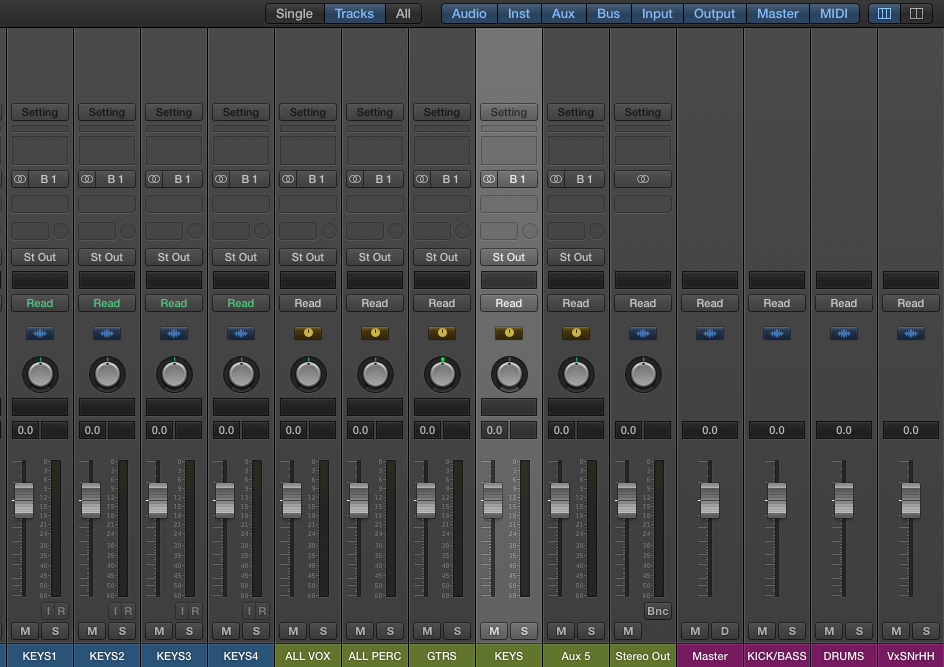
And the answer is...Mix Groups or VCA's!!!


As far as I know, Logic Pro X and Pro Tools 12 all have VCA's as a standard option now, but if you don't have VCA's or Mix Groups in your DAW of choice you can do the same thing with auxes, but it will be a bit more cumbersome.


For my auxes I send all my vocal tracks to a single stereo aux channel and that dumps out to my mix bus. All my drums and percussion go to a stereo aux track which also dumps out to my mix bus. And then all my music (guitars, keys, synths, bass) go to their own stereo aux channel which also dumps out to the mix bus.

I struggled with doing quick revisions for a long while and after a lot of failed revisions, disappointed clients and lost time...I came up with a strategy.

Let's say the revision note is, "bring the kick down". If you only bring the kick down you're going to ruin the flow of your mix balance. So, I have my bass and kick routed to the same VCA, so if I need to pull the kick down I don't lose the blend of my bass and kick.

"Turn up the vocal a half dB"

I have my hi-hat, snare and lead vocal channels routed to the same VCA. After you setup a solid blend for your hi-hat, snares and lead vocals, you don't want to lose them because of a simple revision. Route them the same so your hard work isn't gone because of one note.


Effects are another blend you don't want to easily ruin. Any instrument channel or vocal that has an effect channel it's being sent to I'll always route those with the VCA or Mix Group. Any delays or reverbs being used on the vocal are routed to that vocal, snare, hi-hat VCA I was telling you about. If the snare has a plate reverb those channels get routed as well.

You get the idea.

You can take this idea and adopt it and mold it for your your workflow and to fit your purposes.

Good luck and as always...

be kind+make good music.

Wednesday, October 12, 2016

How to Make Shareable Video Content

It's no secret that videos are the leader for content online. Videos are the future and if you create good ones, it can do well for your music.

Here are a few short tips to creating not only viewable, but shareable videos.


1. Have a strategy. If you don't know where you're heading, you'll never get there. Have a plan for what kind of videos you want to release. Do you want to release tour diaries? How to play the song? Song meanings? Creating the song?
Have a game plan and stay consistent.

2. To be continued. It's as effective as it was years ago. Strategically placed cliff hangers bring people back. Don't say it in ten minutes when you could say it in 5 videos that are 2 minutes each. The population is more ADD with every passing year so keep it short.

3. Be consistent. Keep to a schedule. Find a good time and frequency for you to post and keep to it. The consistency will make your fans trust you. Not keeping to a schedule will result in dropped viewers and less subscribers.

4. Promote yourself. If you have other social media platforms, tell your viewers. They won't know unless you tell them.

be kind+make good music.

Tuesday, October 11, 2016

The New Wild West (Music Business in 2016)

The music industry is the "wild west" now. Sharpest "gun slinger" survives and the weak wither away. It's an EXCITING time to be in this industry...if you have the stones for it.

Gone are the days of bands being fronted large advances to sign a record deal and then buying a luxury car with it. The idea of rock stars is dead, and musicians are as blue collar as any plumber or construction worker.


Today, major indie rock bands have album budgets of $10k or less. Because album sales are so low, it would be foolish to spend much more on making an album.

There are very few slots on a label's roster and if a band can't make that cut, then they have no choice but to front the money themselves from their own pockets. If you don't have the money yourself, you can take to sites like Kick-Starter or other 'crowd-funding' websites and ask for fans to donate money to make your record or fund your tour. The incentive for fans to contribute big money is merchandise, concert tickets, and even private concerts. Instead of large sums like $50-100k awarded to make a record you can take three years on, now you have to plead for every dime to make a record that costs a tenth of the price which you have to deliver by the end of the year.

After the record is finished, bands don't snub their noses at indie blogs with no budget anymore. All press is gold now. Artists get paraded from interview to interview, radio show to in-store performance, just to sell 5,000 copies of their record. You play your heart in an unplugged performance to a camcorder for a site that has nearly zero following to gain 3 more fans. Nothing comes easy any more.

If you as an artist are lucky enough to play a late night talk show or 'Good Morning America' that might account to another few hundred copies sold...if you're lucky.

You may have heard that touring is the 'life blood' of the new music industry, but for many artists it's a cost not a profit. You save money to go on tour. Even signed bands barely break $3,000 per night on the road. A fact that keeps many of them on the road for 3-4 years at a time, taking small 'pit stops' to make a new record to tour behind.

Artists are forced to play the same state sometimes three times in support of a single record. It used to be uncommon that you'd see a band in your city twice in a year, now you can wait till they come back. This also results in smaller attendances, because...well...there's no rush.

But it's not all bad.

Yeah, you have to learn to work social media as effectively as a hammer and your online etiquette is the directly decides if you eat or not that week, but that same power allows you to release whatever you want. If you want to put out a coloring book from your current record...if you can fund it...you can do it! Even if you're signed to an established record label, if the fans demand it they're not gonna say no. You can release as many projects as you'd like as the fans demand, in fact, over-exposure is a good problem to have in the new model of the industry.

Thanks to sites like Periscope bands can have the eyes of their fans on them all day, every day. And some do...because...whatever it takes to make it these days!

The 'Wild West' is brutal and exciting. It forces out those who don't fully love it, because working at a coffee shop or being a clerk at a grocery store for many would make you more money. But those who love it...you're now surrounded by passionate/driven people.

Here's the good news! It's not impossible and you very well could make a living with your music. But you're gonna need to be smart and business savvy. Keep checking in for more posts on tips and strategies to help you make it in the new music industry.

Till next time...

be kind+make good music.

Monday, October 10, 2016

Lessons to Take Away From Your Day Job

Have you ever been told, "don't quit your day job"? They might have been right, but not because you don't have what it takes to make it in your dream, but because your job is a great training ground for the music industry. If you put in the hours and soak up as much as you can from day job, then you'll be better for it!


1. Keeping Regular Hours: You have to treat your career in music like a regular job. Keep a regular set of hours. Those hours can start at 1am if you can make it work, but keeping a schedule is healthy and good.

2. Customer Service: Treating people right will get you far and just like your day job...treating them wrong could result in you getting fired. Learning how to deal with difficult people is a priceless skill, if you get to do that daily at work then it'll better prepare you for your life in music.

3. Good Accounting: Just because your job is behind a microphone or on the other side of the glass, doesn't mean you can act irresponsible with your money. Practicing good book keeping and having an account for every dollar in and out will save you in the long run. If you sell a t-shirt, is there a record for that sale? Manage your money well and your career will be much easier.

4. Sell, Sell, Sell: "A good salesman is one who can sell himself before his products". That's how the quote goes. This is true for the music industry as well. There are so many people aiming for the same thing as you and the "gatekeepers" of this industry can be jaded, how are you gonna make them believe you? You have to make money to be a professional. Who's pocket is that money gonna come from and how to plan to make them part with it? Practice your salesmanship.

5. Mission Minded: The easiest way to fail is to have no goals. You need to treat this like any business. You need a mission statement, you need policies, and you need concrete goals.

6. Business Communication: Can you write a compelling email with proper grammar and spelling? How are you over the phone? Can you speak without saying "umm" too much? Can you negotiate in a professional manner? If you've answered no to these, you may need to read your employee handbook at work again and get in some practice.

7. Punctuality: Being on time is the difference between money in your pocket and money leaving it. If you schedule a session from 4-8pm and you arrive at 5:30pm, you paid for that hour and a half regardless that you were stuck in traffic. Learn to plan ahead and be known as someone who's punctual.

be kind+make good music.

So You Want Your Music on TV?

Once you find the right avenue to get your music to a music supervisor's desk there's a few things you can do right that will help your chances so your music doesn't get pushed into the waste basket.

1. Presentation is key. Get great album artwork. It doesn't have to be colorful, but it does need to be engaging. Here's where I go against the majority. Having a cartoon version of yourself or the other countless cliches I see on mix tapes doesn't necessarily constitute engaging. Keep in mind how many CD's this person receives. You want to stick out of the heap. You want your's on first glance to say, "I'm different and I won't disappoint you like the rest".

Here are a few examples that caught my eye...


Sunday, October 9, 2016

3 Easy Things You Can Do to Improve Your Mixes (That Require No Talent)

I'm pretty hesitant to write on mixing as the internet is flooded with advice on the subject. Some of it's good and some of it's bad, today I'll bring up a few things that I've been taught that improved my mixes.

Mixing is a game of balance, but it can be more difficult to balance your track if you have too many things to juggle. Here's a few tips on how to alleviate some of those variables so you can just concentrate on mixing.


1. Speakers

This is the most important one.

Find the right spot for your speakers and then...don't move them. I'll let you watch a video or read a book on how high and what angle you should point them at. It depends on how your speakers disperse sound, so it's a case by case basis. Keeping your speakers the same is only one part of the equation though...

2. Volume 

I try to mark a few spots on my monitor control that I'll set my volume knob go to, that way I know if something is too quiet or too loud in context with the mix. I've marked those spots off with tape and my monitor control knob always stays within that ballpark.

3. You  

It's not enough to set your speakers in the same place with the same volume, your ears and the distance to that audio is as important as everything else. Sit in the same chair, at the same height when you go to mix. If you need to, mark a spot on the floor where the front of the legs should touch, so you're always a similar distance and height from your desk/monitors.

Why? 

Why go through all that hassle and be so strict on silly things like how high your chair is. Sound changes and our perception of frequency changes depending on distance. But the reason I jump through all these hoops when working on music is the only variable I want to be different is the source material. If I control everything I can on my end then when I hear a kick drum that's a bit too loud or to bright, I'll know it, or a vocal with a few too many high-mids. After doing enough work with those same controlled variables, you'll get used to what good work sounds like in your room and when it doesn't it'll stick out. When it does you can make the needed change quickly with all confidence that it's the right decision.

There ya go. 3 simple tips that will improve your mixing today. Go try this stuff out and see if it makes your more productive. 

be kind+make good music.